

By Cat Dibley
Here’s the thing nobody tells you about arts grant writing in Australia: assessors aren’t looking for the most talented artist. They’re looking for the artist who can best prove they’ll deliver what they’re promising.
I know. Devastating, right?
But after a decade of assessing grants for organisations like The American Australian Association and Create NSW, I’ve read hundreds of applications. And I can tell you exactly what makes an assessor lean forward in their chair versus what makes them reach for their third coffee and wonder if it’s too early for wine.
Grant rounds are open across the country right now — Creative Victoria’s Creative Projects Fund just opened (closing April 16), Arts Queensland closes April 13. Create NSW rounds open in April, Create SA open in May, and Creative Australia opens in June — which is exactly the kind of timeline that feels comfortable right up until it doesn’t. There’s no better time to understand what’s actually happening on the other side of that submit button.
Because here’s the secret: grant writing for artists in Australia isn’t about being the best artist. It’s about being the best communicator of your artistic vision.
The Uncomfortable Truth About Arts Grant Assessment Criteria
Let me paint you a picture. It’s 7pm on a Tuesday. Your assessor has already read 47 applications today. Their eyes are glazing over. They’ve seen seventeen variations of “This project will bring the community together through the transformative power of art.”
Your application lands in front of them.
What happens next depends entirely on whether you’ve understood this: assessors are looking for evidence, not poetry.
The guidelines every funding body publishes? They’re not suggestions. They’re literally the marking rubric. Artistic merit, cultural impact, feasibility, reach — these aren’t just nice words. They’re weighted criteria that your application gets scored against.
Most artists I coach make the same mistake: they write about their vision like it’s a manifesto. Beautiful, passionate, completely unassessable.
What assessors actually need is proof that you can do what you say you’ll do.
Breaking Down What “Artistic Merit” Really Means
“Artistic merit” sounds deliberately obscure, doesn’t it? Like jargon designed to keep artists guessing whether they’re “good enough.”
But here’s what it actually means to an assessor: Is this artist working at a professional level, and is this project pushing them (or their artform) somewhere new?
They’re looking for:
- Evidence of your track record – Not your entire CV, but strategic examples that prove you can deliver quality work. That exhibition you had in 2019? Only relevant if it demonstrates skills you’ll use in this project.
- Clear artistic intent – What are you actually trying to achieve artistically? “Exploring themes of identity” is vague. “Using participatory ceramics workshops to document intergenerational trauma narratives in migrant communities” is specific.
- Innovation within context – You don’t need to reinvent the wheel, but you do need to show how this project extends your practice or contributes something fresh to your artform.
Here’s a real example (details changed): An artist applied for funding to create a solo exhibition. Their first draft said, “I want to explore the intersection of nature and technology through mixed media.”
That’s a vibe, not a project.
After coaching, their application said: “This exhibition continues my five-year exploration of bio-fabrication, introducing a new technique combining mycelium growth with e-waste components. In 2024 I completed a residency at Kunsthalle Wien specifically to develop this process. The resulting works physically digest obsolete electronics — responding to a documented gap in public engagement with Australia’s growing e-waste crisis and turning waste into art that documents its own making.”
See the difference? Evidence, specificity, and a clear artistic trajectory.
Feasibility: Or, “How to Prove You Won’t Ghost Us With the Money”
Arts funding in Australia is competitive. Really competitive. Funding bodies can literally receive hundreds more applications than they can fund.
So when assessors look at feasibility, they’re asking: If we give this artist $25,000, will they actually deliver what they’re promising?
They’re checking:
- Your budget makes sense – Not just mathematically (though yes, it needs to add up), but conceptually. If you’re applying for $30k, with no other source of income, but your project description suggests $80k worth of ambition, that’s a red flag. If you’ve budgeted $500 for “materials” on a large-scale sculptural work, assessors know you haven’t thought this through.
- Your timeline is realistic – Saying you’ll deliver a 20-piece exhibition in three months while working full-time and you’ve never shown more than five pieces at once? Assessors will notice.
- You’ve got the skills/team to deliver – This is where your bio and support letters matter. If you’re proposing a technically complex digital installation but your track record is all watercolours, you’d better have a kick-arse technical collaborator on board.
The biggest mistake I see in how to write an arts grant application? Artists undersell their own capability. They’re so focused on being humble that they forget to demonstrate competence.
You need to walk the line between confidence and arrogance. Show them you’ve done your homework, you understand what’s required, and you’ve got the runs on the board to deliver.
Cultural Impact: Stop Saying “Community Engagement” Without Proof
Every assessor I know has a drinking game for the phrase “meaningful community engagement.” (We don’t actually drink while assessing. But we think about it.)
Here’s what cultural impact actually means: Who benefits from this project existing, and how do you know?
Not hypothetically. Not “I hope this will inspire people.” Specifically.
When you’re working out how to get arts funding in Australia, you need to answer:
- Who is your audience? And no, “everyone” is not an answer. Even “the general public” is too vague. Be specific: “Emerging artists aged 20-35 in regional NSW” or “Korean-Australian elders in Western Sydney” or “High school students in low-SES areas exploring STEM careers.”
- What change are you creating? This is where you prove impact. Are you creating new work? Building capacity? Shifting perspectives? Documenting something that would otherwise be lost? Be explicit.
- How will you measure/demonstrate that impact? This is the bit most people skip. Attendance numbers? Participant testimonials? Documentation of new skills learned? Media coverage? Don’t just promise impact – show how you’ll prove it happened.
I worked with a theatre-maker who initially wrote (details changed to protect the funded): “This play will start important conversations about climate change.”
After workshopping, they wrote: “This work will reach 1,200 regional NSW high school students through our existing school touring network, with post-show workshops facilitated by climate scientists. Our 2023 touring show achieved 94% positive feedback on ‘increased understanding of scientific concepts,’ and evaluation surveys will measure shifts in climate literacy and agency.”
Which one would you fund?
The Two Things That Make Assessors Fight for Your Application
After hundreds of applications assessed, I can tell you there are two things that make an assessor become your champion in the funding round:
1. Clarity
If an assessor has to re-read your sentence three times to understand what you’re actually proposing, you’ve lost them. Clear writing = clear thinking = fundable project.
2. Specificity
Vague promises are unfundable. Specific, detailed plans with evidence show you’re serious.
An arts grant coach (hi, that’s me) will tell you: the best applications aren’t written by the most talented artists. They’re written by artists who understand that grant writing is a specific skill that can be learned.
What to Do If This All Feels Overwhelming
Look, I get it. You became an artist to make art, not to write grant applications that read like project management reports.
But here’s the thing about applying for arts funding in Australia: it’s a skill. Like throwing a pot or mixing colours or writing dialogue. It can be learned.
Some artists learn by doing it badly a few times. Some learn by reverse-engineering successful applications. And some work with an arts grant coach who’s sat on both sides of the assessment table.
If you’re reading this thinking “I have no idea how to translate my brilliant, messy, complicated practice into language assessors can actually score,” you’re not alone. That’s literally what I help artists do. And I know how to do it without losing the soul of the work.
Right. So now what?
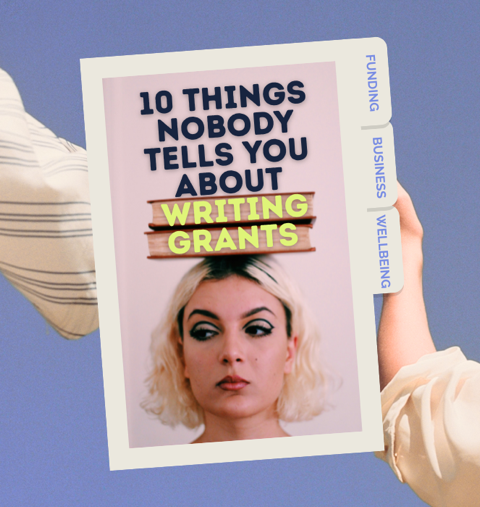
Download my free checklist: 10 Things Nobody Tells You About Writing Grants. It covers 10 specific things assessors flag when scoring applications — including six that didn’t make it into this article — and it’s designed to sit open next to you while you’re actually writing.
Your practice deserves proper funding. Let’s make sure you’re asking for it in a way that gets results.
About the Author: Cat Dibley
Cat Dibley is a creative business coach and arts strategist with over 13 years on both sides of the arts funding table — she’s written the applications, sat on the panels, and run the programs. To date she’s personally secured over $3.6 million in arts funding and managed grant programs worth $2.5 million across NSW. She helps artists and creative businesses get funded without losing their minds (or their artistic integrity). Based on Awabakal Country in Newcastle, NSW, she works with artists nationally through one-on-one coaching and a range of grant writing courses and programs — from self-paced learning to hands-on application support.
Discover everything about Cat at www.catdibley.com.
Learn More in our Upcoming workshop with Cat: Funding Fundamentals
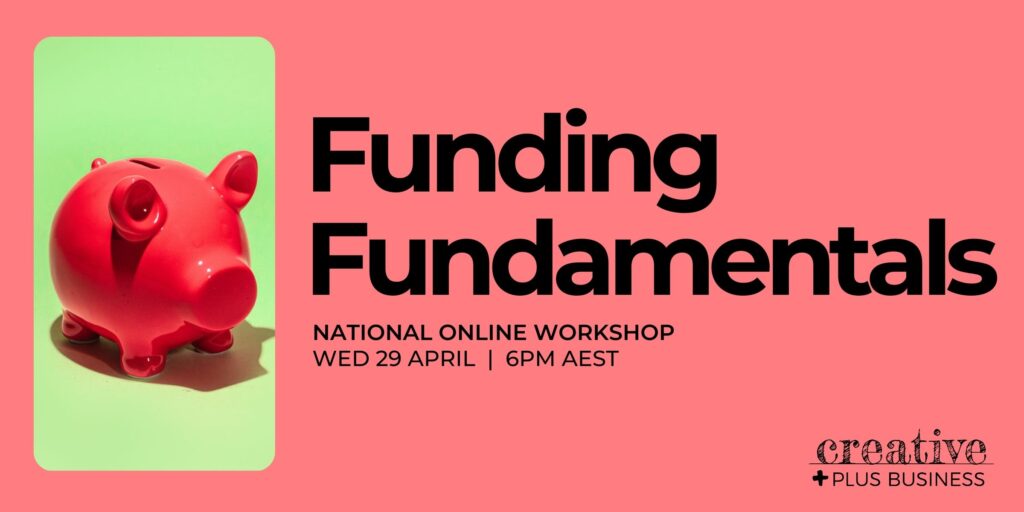
Funding Fundamentals is a workshop showcasing the basics of preparation, application, and acquittal for any kind of funding, as well as getting organised for future applications. It’s packed with information and suitable for novices and more experienced funding-seekers alike.
It’s happening on Wednesday 29 April at 6pm AEDT
Register here to secure your spot.



0 Comments