


By Monica Davidson
The words ‘strategic planning’ are the last you want to hear if you’re a freelance creative or running a small arts business, and everything feels like it’s being held together with gaffer tape and dwindling hope. Costs are up, clients don’t want to pay, funding is bleak and just surviving the week can feel like an Olympic sport. You don’t want to plan, you want to crawl back into bed with a glass of wine and pull the doona over your head.
And yet, now is the perfect time for a strategy, as long as it’s the right kind. I’m not talking about a traditional, stuffy corporate business plan with a five-year vision and a SWOT analysis nobody will ever look at again. I’m talking about something much smaller and much more useful: a plan that fits the size of your actual capacity right now, today, in the middle of the bin fire.
Here are 8 simple ways to get started on strategy and make a plan for the future (that you can create from your bed with that wine).
1. Start with what’s actually true, even if it’s scary.
When everything feels uncertain, it’s easy to catastrophise. Before you plan anything, get honest about the immediate future. How much work do you have? What’s coming in, and what’s just a maybe? How much money is actually in the bank? Are your budgets up to date? The best thing about money is that it never lies to you. Replacing vague dread with specific facts is terrifying in the short term, but better than the exhaustion of not knowing. The truth, even when it’s scary, is the bedrock of a plan that will actually work.
2. Shrink the Timeframe
Forget the year ahead. When the world is volatile, plan in 90-day chunks.What do you need to happen in the next three months for this business to be OK? Start there, and work backwards. A short timeframe is a manageable and practical period that your brain can actually hold onto, rather than struggling with a 12 month strategy of unknown chaos and giving up before you’ve even started.
3. Focus on Easy-Money-Now
Hopefully you have a selection of jobs that pays the bills today, and other work that builds something bigger and more creative for tomorrow. When times are tight, easy-money-now work isn’t selling out, it’s strategy. Maximise your energy for those ‘workhorse’ jobs, the reliable bread-and-butter gigs that pay the rent and keep the lights on without destroying your soul. Go back to teaching, consulting, project management, corporate gigs. Think about commissions, content work, editorial, events, arts admin. Make work that is repeatable, sellable and small. If you have to drive an Uber or wait tables in the short-term, so be it. This bin fire will not last forever, and it may not be your dream, but surviving until that better time is the goal.
Read more about Unicorns and Workhorses here!
4. Make Time for Your Unicorns.
Your ‘Unicorns’ are the projects that express your creativity and feed your soul. They are the shiny and magical songs we have to sing, the poems we need to write, the dances we simply must do, the stories we have to tell. Even while money is the focus, include some time and energy for your Unicorns as well. It’s important to keep your magical creatures watered and fed in these tough times, because when things get better (and they will), you’ll want to get those longer-term creative projects going again.
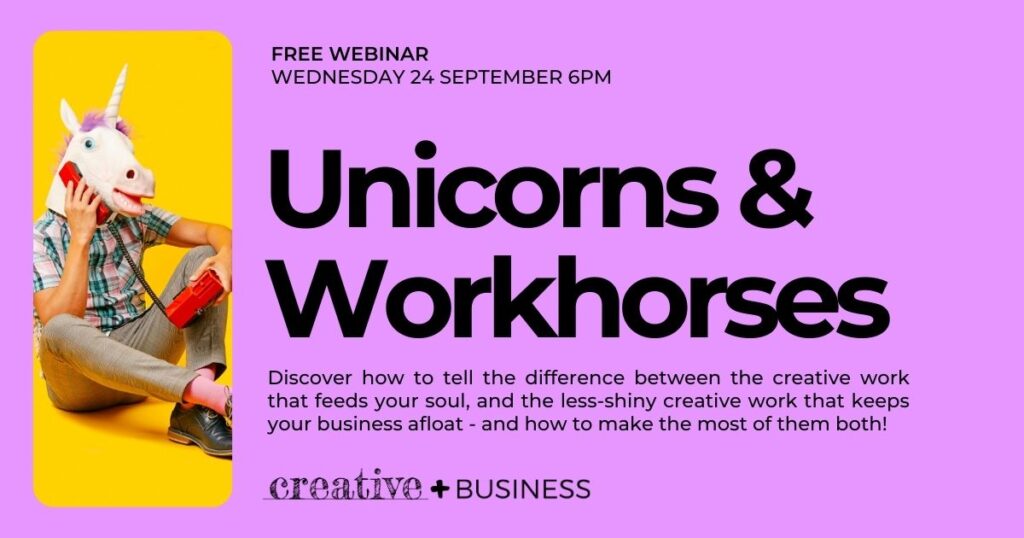
Want more? Watch our recent Unicorns & Workhorses Webinar.
5. Cut the things you’re doing out of guilt, not value.
Look hard at your offerings, your client list, your side projects. Is there something you’re hanging onto because you feel you ‘should’, rather than because it’s actually working? Tough times are a good filter for separating the obligations from the opportunities. Quitting a project or sacking a bad client isn’t failure, it’s editing. Your resources are precious at the moment, and you haven’t got much to spare. Use them wisely.
6. Turn Off Your Inner Critic (and Get a Buddy)
Trying to plan alone in a dark room while stressed is a recipe for an existential crisis. Don’t do it. Find a trusted peer, a fellow freelancer, or a professional mentor. Go somewhere noisy, grab a coffee, and brainstorm the best ideas to solve your current business bottlenecks. Strip away your critical faculties for a couple of hours and just play. You’ll be surprised at what practical gems emerge from a bit of shared creative chaos.
7. Burn the Big Plan and Go for One Page
If a plan takes months to write, it’s already obsolete by the time you finish it. Strip your strategy down to the absolute essentials. What is your immediate purpose? Who is your audience right now? What are the basic admin rules keeping you sane? Focus on a One-Page Business Plan coupled with a short-term 12-Week Action Plan.

Our one-page creative business plan is free to download – get it here.
8. Make the plan small enough to survive a bad week
A plan you can’t stick to on your worst day isn’t a plan, it’s a waste of time that’s also setting you up to feel like a failure. Plan with the assumption that you’ll feel a bit rubbish and everything will be hard. Build in contingencies. Make deliberate time for rest and wellbeing. Go back to those creative resource replenishers like a visit to the art gallery, a walk with friends, or The Artist’s Way. Create the habit of regular check-ins with yourself, like the Monday Morning Meeting and Money Day. Tiny plans and baby steps are the way through, as long as you stick to them.
It’s true, none of these steps will lower interest rates, fix the economy, or bring clients your way with bags of cash. However, looking to the future in a small way, even as a reluctant bare-minimum strategy, will give you a sense of direction and control when everything else feels like it’s spinning. You don’t have to feel motivated to make a plan, you just need something that will help you navigate your way through the flames. Keep it short, keep it nimble, and give yourself some grace.
Hang in there. You’ve got this!





A good sensible article. Very do-able.